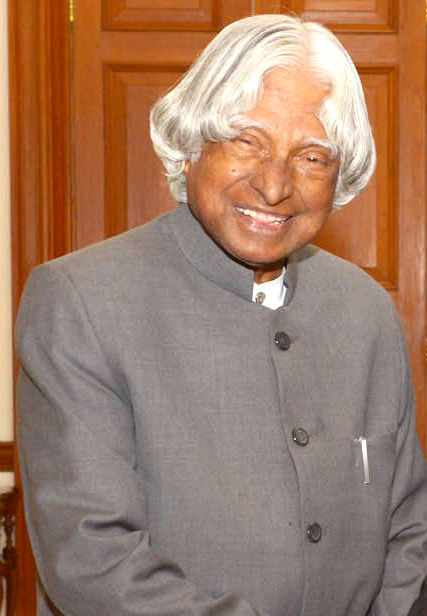
Avul Pakir Jainulabdeen Abdul Kalam was an aerospace scientist who served as the 11th President of India from 2002 to 2007. He was born and raised in Rameswaram, Tamil Nadu and studied physics and aerospace engineering. He spent the next four decades as a scientist and science administrator, mainly at the Defense Research and Development Organisation (DRDO) and Indian Space Research Organisation (ISRO) and was intimately involved in India’s civilian space program and military missile development efforts. He thus came to be known as the Missile Man of India. Kalam was elected as the 11th President of India in 2002, widely referred to as the “People’s President”. He was awarding as a Bharat Ratna, India’s highest civilian honor.
“All birds find shelter during a rain. But the eagle avoids rain by flying above the clouds. Problems are common, but attitude makes the difference!”
— A. P. J. Abdul Kalam
early life:
Abdul Kalam was born on 15 October 1931 to a Tamil Muslim family in the pilgrimage center of Rameswaram on Pamban Island. His father Jainulabdeen was a boat owner and imam of a local mosque; his mother Ashiamma was a housewife. His father owned a ferry that took Hindu pilgrims back and forth between Rameswaram the now uninhabited Dhamsukhodi. Kalam was the youngest of four brothers and one sister in his family. Their business had involved trading groceries between the mainland and the island and to and from Sri Lanka, as well as ferrying pilgrims. As a result, the family acquired the title of “Mara Kalam Iyakkivar”, which over the years became shortened to “Marakier.”
EARLY EDUCATION:
In his school years, Kalam had average grades but was described as a bright and hardworking student who had a strong desire to learn. He spent hours on his studies, especially mathematics. While Kalam was working on a senior class project, the Dean was dissatisfied with his lack of progress and threatened to revoke his scholarship unless the project was finished within the next three days. Kalam met the deadline, impressing the Dean, who later said to him, “I was putting you under stress and asking you to meet a difficult deadline”. He narrowly missed achieving his dream of becoming a fighter pilot, as he placed ninth in qualifiers, and only eight positions were available in the IAF.
Career as a scientist:
He started his career by designing a small hovercraft, but remained unconvinced by his choice of a job at DRDO. Kalam was also part of the INCOSPAR Committee working under Vikram Sarabhai, the renowned space scientist. n 1969, Kalam was transferred to the ISRO, where he was the project director of India’s first Satellite Launch Vehicle, which successfully deployed the Rohini satellite in near-earth orbit in July 1980; Kalam had first started work on an expandable rocket project independently at DRDO in 1965.
“This is my belief: that through difficulties and problems God gives us the opportunity to grow. So when your hopes and dreams and goals are dashed, search among the wreckage, you may find a golden opportunity hidden in the ruins.”
— A. P. J. Abdul Kalam
 Social Media Power